34 Best Sights in Milan, Italy

Background Illustration for Sights

We've compiled the best of the best in Milan - browse our top choices for the top things to see or do during your stay.

Duomo

Duomo Fodor's choice
MILAN - DECEMBER 11: Tourists at Piazza Duomo on December 11, 2009 in Milan, Italy. As of 2006, Milan was the 42nd most visited city worldwide, with 1.9 million annual international visitors
Luciano Mortula / Shutterstock

There is no denying that for sheer size and complexity, the Duomo is unrivaled in Italy. It is the second-largest church in the country—the largest being St. Peter's in Rome. This intricate Gothic structure has been fascinating and exasperating visitors and conquerors alike since it was begun by Gian Galeazzo Visconti III (1351–1402), first duke of Milan, in 1386. Consecrated in the 15th or 16th century, it was not completed until just before the coronation of Napoléon as king of Italy in 1809.

The building is adorned with 135 marble spires and 2,245 marble statues. The Duomo's most famous sculpture is the gruesome but anatomically instructive figure of San Bartolomeo (St. Bartholomew), who was flayed alive. As you enter the apse to admire those splendid windows, glance at the sacristy doors to the right and left of the altar. The lunette on the right dates from 1393 and was decorated by Hans von Fernach.
Piazza del Duomo, Milan, 20122, Italy
02-72023375
Sight Details
Cathedral, museum, and archaeological area €14; stairs to roof €14; elevator €16; fast-track skip the line with elevator €26

Something incorrect in this review?

Galleria Vittorio Emanuele II

Duomo Fodor's choice
Milan. Very big shop.; Shutterstock ID 2375626; Project/Title: Best of Europe; Downloader: Melanie Marin
chaoss / Shutterstock

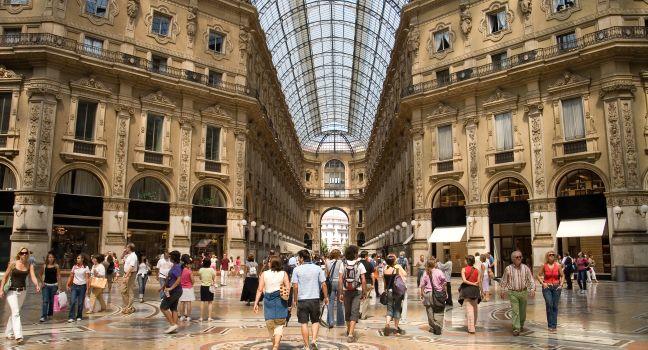
This spectacular late-19th-century Belle Époque tunnel is essentially one of the planet's earliest and most select shopping malls, with upscale tenants that include Gucci and Prada. This is the city's heart, midway between the Duomo and La Scala. It teems with life, which makes for great people-watching from the tables that spill out from bars and restaurants, where you can enjoy an overpriced coffee. Books, clothing, food, hats, and jewelry are all for sale. Known as Milan's "parlor," the Galleria is often viewed as a barometer of the city's well-being.

Piazza del Duomo, Milan, 20121, Italy

Something incorrect in this review?

The Last Supper/Il Cenacolo/Santa Maria delle Grazie

Sant'Ambrogio Fodor's choice
Milan, Italy, Santa Maria delle Grazie, Unesco World Heritage for its masterpiece The Last Supper by Leonardo;
Luca Grandinetti / Shutterstock

Leonardo da Vinci's The Last Supper, housed in this church and former Dominican monastery, has had an almost unbelievable history of bad luck and neglect. Its near destruction in an American bombing raid in August 1943 was only the latest chapter in a series of misadventures, including—if one 19th-century source is to be believed—being whitewashed over by monks. After years of restorers patiently shifting from one square centimeter to another, Leonardo's masterpiece is free of centuries of retouching, grime, and dust. Astonishing clarity and luminosity have been regained, helped by lighting, and a timed entry system where small groups are ushered into climate-controlled rooms with automatic glass doors, to prevent humidity.

Despite Leonardo's carefully preserved preparatory sketches, in which the apostles are clearly labeled by name, there still remains some small debate about a few identities in the final arrangement. There can be no mistaking Judas, however—small and dark, isolated from the terrible confusion that has taken the hearts of the others. Reservations are required to view the work. Viewings are in 15-minute timed-entry slots, and visitors must arrive 30 minutes before. Reservations can be made online. Reserve at least three weeks ahead if you want a Saturday slot, two weeks for a weekday slot. Some city bus tours include a visit in their regular circuit, which may be a good option.

Recommended Fodor's Video

Fondazione Prada

Porta Romana Fodor's choice

New structures of metal and glass and revamped buildings once part of a distillery from the 1910s now contain this museum's roughly 205,000 square feet. The modern art showcased here is not for the faint of heart. Permanent pieces, such as Haunted House, featuring works by Louise Bourgeois and Robert Gober, are avant-garde and challenging, and temporary exhibitions highlight cutting-edge Italian and international artists. Don't hesitate to ask one of the helpful, knowledgeable staffers for guidance navigating the expansive grounds, which can be confusing. And don't miss the Wes Anderson–designed café, Bar Luce, for a drink or snack, or the restaurant Torre for an aperitivo or a full meal with panoramic views from on high. The Fondazione is a hike from the city center; expect a 10-minute walk from the metro station to the galleries.

Navigli District

Navigli Fodor's choice

In medieval times, a network of navigli, or canals, crisscrossed the city. Almost all have been covered over, but two—Naviglio Grande and Naviglio Pavese—are still navigable. The area's chock-full of boutiques, art galleries, cafés, bars, and restaurants, and at night the Navigli serves up a scene about as close as you will get to southern Italian–style street life in Milan. On weekend nights, it is difficult to walk among the youthful crowds thronging the narrow streets along the canals. Check out the antiques fair on the last Sunday of the month from 9 to 6. During the summer months, be sure to put on some mosquito repellent.

Palazzo Reale

Duomo Fodor's choice

Elaborately decorated with painted ceilings and grand staircases, this former royal palace close to the Duomo is almost worth a visit in itself; however, it also functions as one of Milan's major art galleries, with a focus on modern artists. Exhibitions have highlighted works by Picasso, Chagall, Warhol, Pollock, and Kandinsky. Check the website before you visit to see what's on; purchase tickets online in advance to save time in the queues, which are often long and chaotic.

Pinacoteca di Brera

Brera Fodor's choice

The collection here is star-studded even by Italian standards. Highlights include the somber Cristo Morto (Dead Christ) by Mantegna, which dominates Room VI with its sparse palette of umber and its foreshortened perspective, Raphael's (1483–1520) Sposalizio della Vergine (Marriage of the Virgin), and La Vergine con il Bambino e Santi (Madonna with Child and Saints), by Piero della Francesca (1420–92), an altarpiece commissioned by Federico da Montefeltro (shown kneeling, in full armor, before the Virgin).

Villa Necchi Campiglio

Palestro Fodor's choice

In 1932, architect Piero Portaluppi designed this sprawling estate in an Art Deco style, with inspiration coming from the decadent cruise ships of the 1920s. Once owned by the Necchi Campiglio industrial family, the tasteful and elegant three-level home and garden—which sits on Via Mozart, one of Milan's most exclusive streets—is a reminder of the refined, modern culture of the nouveaux riches who accrued financial power in Milan during that era. Don't miss the Collezione Guido Sforni on the second floor behind a closed door of one of the bedrooms, where you'll find 21 original drawings by Henri Matisse, Pablo Picasso, and Amedeo Modigliani among other 20th-century artists. There is also a café on the grounds that is open 10 am–6 pm. An audio tour is included with the entrance fee, and can be listened to on a mobile device. Tours in English are available on Saturday at 11:30 am and 2:30 pm with advanced booking.

Acquario Civico di Milano

Sempione

The third-oldest aquarium in Europe, opened in 1906, is known as much for its Art Nouveau architecture as for its small but interesting collection of marine life. You'll find 36 pools that house more than 100 species of fish, including an emphasis on Italian freshwater fish and their habitat, and one tank of species from the Red Sea. 

Viale Gerolamo Gadio 2, Milan, 20100, Italy
02-88465750
Sight Details
€5; free every 1st and 3rd Tues. of month after 2
Closed Mon.

Something incorrect in this review?

ADI Design Museum Compasso d'Oro

Garibaldi

More than 350 of the most renowned Italian industrial design objects are showcased in this former Enel electricity plant. The items in the permanent collection were selected during biennial judging for Compasso d'Oro (Golden Compass) awards from 1954 until today. Some of the exhibits are grouped by category, like cars (1960 Abarth-Fiat Monza Zagato, 1959 Fiat 500, and 2014 Ferrari F12berlinetta) and coffeemakers (Alessi's 9090 from 1979 and Napoletana from 1981).

Piazza Compasso d'Oro, 1, Milan, 20154, Italy
02-36693790
Sight Details
€15
Closed Fri.
Tickets may be purchased online, or at the museum with a credit card or mobile wallet (no cash accepted)

Something incorrect in this review?

Armani/Silos

Tortona

About 600 pieces, from about 1980 to the present, by famed Milanese fashion designer Giorgio Armani are displayed on four floors of this airy 48,000-square-foot museum, housed in a 1950s building that was formerly a Nestlé cereal storage facility. The collection includes many of Armani’s famous suits and clothes worn to the Oscars and other celebrity-studded events. A digital archive lets you explore Armani's full body of work, and a café lets you stop for a restorative espresso. Temporary exhibitions explore photography, architecture, and other themes related to design.

Via Bergognone 40, Milan, 20144, Italy
02-91630010
Sight Details
€12
Closed Mon. and Tues.

Something incorrect in this review?

Basilica di Sant'Ambrogio

Sant'Ambrogio

Milan's bishop, St. Ambrose (one of the original Doctors of the Catholic Church), consecrated this church in AD 387. St. Ambroeus, as he is known in Milanese dialect, is the city's patron saint, and his remains—dressed in elegant religious robes, a miter, and gloves—can be viewed inside a glass case in the crypt below the altar. Until the construction of the more imposing Duomo, this was Milan's most important church. Much restored and reworked over the centuries (the gold-and-gem-encrusted altar dates from the 9th century), Sant'Ambrogio still preserves its Romanesque characteristics, including 5th-century mosaics. The church is often closed for weddings on Saturday.

Battistero Paleocristiano/Baptistry of San Giovanni alle Fonti

Duomo

More specifically known as the Baptistry of San Giovanni alle Fonti, this 4th-century baptistry is one of two that lie beneath the Duomo. Although opinion remains divided, it is widely believed to be where Ambrose, Milan's first bishop and patron saint, baptized Augustine. Tickets also include a visit to the Duomo and its museum.

Piazza del Duomo, Milan, 20123, Italy
02-72023375
Sight Details
€14, including admission to Duomo and museum; €26, including Duomo, museum, and roof with elevator, valid for 72 hrs

Something incorrect in this review?

Casa-Museo Boschi di Stefano

Buenos Aires

To most people, Italian art means Renaissance art, but the 20th century in Italy was also a time of artistic achievement. An apartment on the second floor of a stunning Art Deco building designed by Milan architect Portaluppi houses this collection, which was donated to the city of Milan in 2003 and is a tribute to the enlightened private collectors who replaced popes and nobles as Italian patrons. The walls are lined with the works of postwar greats, such as Fontana, de Chirico, and Morandi. Along with the art, the museum holds distinctive postwar furniture, sculptures, and stunning Murano glass chandeliers.

Castello Sforzesco

Castello

Wandering the grounds of this tranquil castle and park near the center of Milan is a great respite from the often-hectic city, and the interesting museums inside are an added bonus. Highlights include the Sala delle Asse, a frescoed room attributed to Leonardo da Vinci (1452–1519), and Michelangelo's unfinished Rondanini Pietà, believed to be his last work. The pinacoteca (picture gallery) features 230 paintings from medieval times to the 18th century, and the Museo dei Mobili e delle Sculture Lignee (Furniture Museum) includes a delightful collection of Renaissance treasure chests.

Piazza Castello, Milan, 20121, Italy
02-88463700
Sight Details
Castle free, museums €5 (free every 1st and 3rd Tues. of month after 2, and 1st Sun. of month)
Museums closed Mon.

Something incorrect in this review?

Chiesa di San Maurizio al Monastero Maggiore

Sant'Ambrogio

Next to the Museo Civico Archeologico, you’ll find this little gem of a church, constructed starting in 1503 and decorated almost completely with magnificent 16th-century frescoes. The modest exterior belies the treasures inside, including a concealed back room once used by nuns that includes a fascinating fresco of Noah loading the ark with animals, including two unicorns.

Fondazione Luigi Rovati

Porta Venezia

This isn't your typical Etruscan history museum. A seven-year project led by the Luigi Rovati Foundation transformed two levels of a palazzo commissioned by the Prince of Piombino in 1871 into a stone-carved contemporary museum where ancient artifacts stand alongside those from the 20th century and beyond. Digital installations translate Etruscan into English and Italian on some of the objects, while an immersive moving floor map shows the civilization's major cities before its Roman conquest. A rotating display of contemporary exhibits along with permanent works on the main floor continues the play of ancient and modern, such as one where Andy Warhol's interpretation of an Etruscan scene was in the same room as archaeological finds. Giardino Padiglione, and its adjoining Andrea Aprea Bistrot, is an ideal spot for an afternoon aperitif or coffee.

Corso Venezia 52, Milan, 20121, Italy
02-38273001
Sight Details
€16
Closed Mon. and Tues.

Something incorrect in this review?

GAM: Galleria d'Arte Moderna/Villa Reale

Palestro

One of the city's most beautiful buildings is an outstanding example of neoclassical architecture, built between 1790 and 1796. After it was donated to Napoléon, who lived here briefly with Empress Josephine, it became known as the Villa Reale. The collection consists of works donated by prominent Milanese art collectors. It emphasizes 18th- and 19th-century Italian works, but also has a smattering of 20th-century Italian pieces.

Via Palestro 16, Milan, 20121, Italy
02-88445947
Sight Details
€5 (free every 1st and 3rd Tues. of month after 2 pm)
Closed Mon.

Something incorrect in this review?

Giardini Pubblici Indro Montanelli

Porta Venezia

Giuseppe Piermarini, architect of La Scala, laid out these gardens across Via Palestro from the Villa Reale in 1770. Designed as public pleasure gardens, today they are still popular with families who live in the city center. Generations of Milanese have taken a ride on the miniature train and merry-go-round. The park also contains a small planetarium and the Museo Civico di Storia Naturale (Municipal Natural History Museum).

Milano Osservatorio—Fondazione Prada

Duomo

This contemporary photography and visual languages exhibition space, developed in partnership with Fondazione Prada, is spread over two floors in the Galleria Vittorio Emanuele II. Exhibitions, which rotate several times a year, explore the cultural and social implications of expression. The space itself, bombed after World War II and then fully restored, is worth visiting just for the unique view of the Galleria dome through the large windows. You can reach the gallery via the elevator next to the Prada store.

MUDEC (Museo delle Culture)

Tortona

Home to a permanent collection of ethnographic displays as well as temporary exhibitions of big-name artists such as Basquiat and Miró, MUDEC is in the vibrant Zona Tortona area of the city. British architect David Chipperfield designed the soaring space in a former factory. The permanent collection includes art, objects, and documents from Africa, Asia, and the Americas. Book in advance for the most popular temporary exhibits. There’s also a highly rated restaurant, Enrico Bartolini Mudec, as well as a more casual bistro.

Via Tortona 56, Milan, 20144, Italy
02-54917
Sight Details
Permanent collection free, special exhibitions from €16
Closed Mon. until 2:30 pm

Something incorrect in this review?

Museo Bagatti Valsecchi

Quadrilatero

Glimpse the lives of 19th-century Milanese aristocrats in a visit to this lovely historic house museum, once the home of two brothers, Barons Fausto and Giuseppe Bagatti. Family members inhabited the house until 1974; it opened to the public as a museum in 1984. The house is decorated with the brothers’ fascinating collection of 15th- and 16th-century Renaissance art, furnishings, and objects, including armor, musical instruments, and textiles. The detailed audio guide included with admission provides a thorough insight into the history of the artworks and intriguing stories of the family itself.

Museo Civico Archeologico

Sant'Ambrogio

Appropriately situated in the heart of Roman Milan, this museum housed in a former monastery displays everyday utensils, jewelry, silver plate, and several fine examples of mosaic pavement from Mediolanum, the ancient Roman name for Milan. The museum opens into a garden that is flanked by the square tower of the Roman circus and the polygonal Ansperto tower, adorned with frescoes dating to the end of the 13th and 14th centuries that portray St. Francis and other saints receiving the stigmata.

Corso Magenta 15, Milan, 20123, Italy
02-88445208
Sight Details
€5 (free every 1st and 3rd Tues. of month after 2, and 1st Sun. of month)
Closed Mon.

Something incorrect in this review?

Museo del Novecento

Duomo

Ascend a Guggenheim-esque spiral walkway to reach the modern works at this petite yet dense collection of Italian contemporary art, adjacent to the Duomo. The museum highlights 20th-century Italian artists, including a strong showing of Futurists, like Boccioni and Severini, and sculptures from Marini, along with a smattering of works by other European artists, including Picasso, Braque, and Matisse.

Via Marconi 1, Milan, 20100, Italy
02-88444061
Sight Details
€5 (free every 1st and 3rd Tues. of month after 2)
Closed Mon.

Something incorrect in this review?

Museo Nazionale della Scienza e Tecnologia Leonardo da Vinci

Sant'Ambrogio

This converted cloister is best known for the collection of models based on Leonardo da Vinci's sketches. One of the most visited rooms features interactive, moving models of the famous vita aerea (aerial screw) and ala battente (beating wing), thought to be forerunners of the modern helicopter and airplane, respectively. The museum also houses a varied collection of industrial artifacts, including trains, and several reconstructed workshops, including a watchmaker's, a lute maker's, and an antique pharmacy.

Museo Poldi-Pezzoli

Quadrilatero

This exceptional museum, opened in 1881, was once a private residence and collection, and contains not only pedigreed paintings but also porcelain, textiles, and a cabinet with scenes from Dante's life. The gem is undoubtedly Portrait of a Lady by Piero del Pollaiolo (1431–98), one of the city's most prized treasures and the source of the museum's logo. The collection also includes masterpieces by Botticelli (1445–1510), Andrea Mantegna (1431–1506), Giovanni Bellini (1430–1516), and Fra Filippo Lippi (1406–69).

Via Manzoni 12, Milan, 20121, Italy
02-794889
Sight Details
€15
Closed Tues.

Something incorrect in this review?

Palazzo Citterio

Brera

Emilio and Maria Jesi were among the great Italian art collectors of the 20th century. Some of their treasured works from Pablo Picasso and Amedeo Modigliani are part of the permanent collection in this four-level museum, which opened at the end of 2024, and merges a modern building by Mario Cucinella (who also designed the Fondazione Luigi Rovati museum in Porta Venezia), with an 18th-century palazzo that was once the Jesi family home. Highlights from the permanent galleries on the first floor also include works by Umberto Boccioni and Georges Braque and paintings from the Pinacoteca di Brera (Brera Art Gallery). Temporary exhibitions on the second and ground floors have focused on contemporary art and the history of the Brera neighborhood.

Via Brera 12, Milan, 20121, Italy
02-72105141
Sight Details
€12 (€20 includes Pinacoteca di Brera)
Closed Mon.--Wed.

Something incorrect in this review?

Parco Sempione

Sempione

Originally the gardens and parade grounds of the Castello Sforzesco, this open space was reorganized during the Napoleonic era, when the arena on its northeast side was constructed, and then turned into a park during the building boom at the end of the 19th century. It is still the lungs of the city's fashionable western neighborhoods, and the Aquarium still attracts Milan's schoolchildren. The park became a bit of a design showcase in 1933 with the construction of the Triennale.

Piazza Gae Aulenti

Garibaldi

Welcome to the modern era. The piazza named for the famed Italian female architect is a stroll into the future of architectural design. Here you'll find Italy's tallest skyscraper (the 757-foot mirrored and spired UniCredit Tower), IBM Studios (a curved and wood-slatted innovation lab), a Tesla dealership, and an LED tree surrounded by reflective pools. Linger through a botanical garden, Biblioteca degli Alberi (library of trees), and join locals picnicking when the weather cooperates.

Piazza Gae Aulenti, Milan, 20124, Italy

Something incorrect in this review?

Pinacoteca Ambrosiana

Duomo

Cardinal Federico Borromeo, one of Milan's native saints, founded this picture gallery in 1618 with the addition of his personal art collection to a bequest of books to Italy's first public library. The core works of the collection include such treasures as Caravaggio's Basket of Fruit, Raphael's monumental preparatory drawing (known as a "cartoon") for The School of Athens, which hangs in the Vatican, and Leonardo da Vinci's Portrait of a Musician. The highlight for many is Leonardo's Codex Atlanticus, which features thousands of his sketches and drawings.

Piazza Pio XI 2, Milan, 20123, Italy
02-806921
Sight Details
€17
Closed Wed.

Something incorrect in this review?